The Nitrogen Cycle: Why a New Aquarium Needs Weeks Before Fish
The most expensive mistake in the hobby costs nothing to avoid: filling a tank on Saturday and buying fish on Sunday. What a new aquarium lacks is not equipment. It is a bacterial population, and bacteria keep their own schedule.
What actually poisons fish
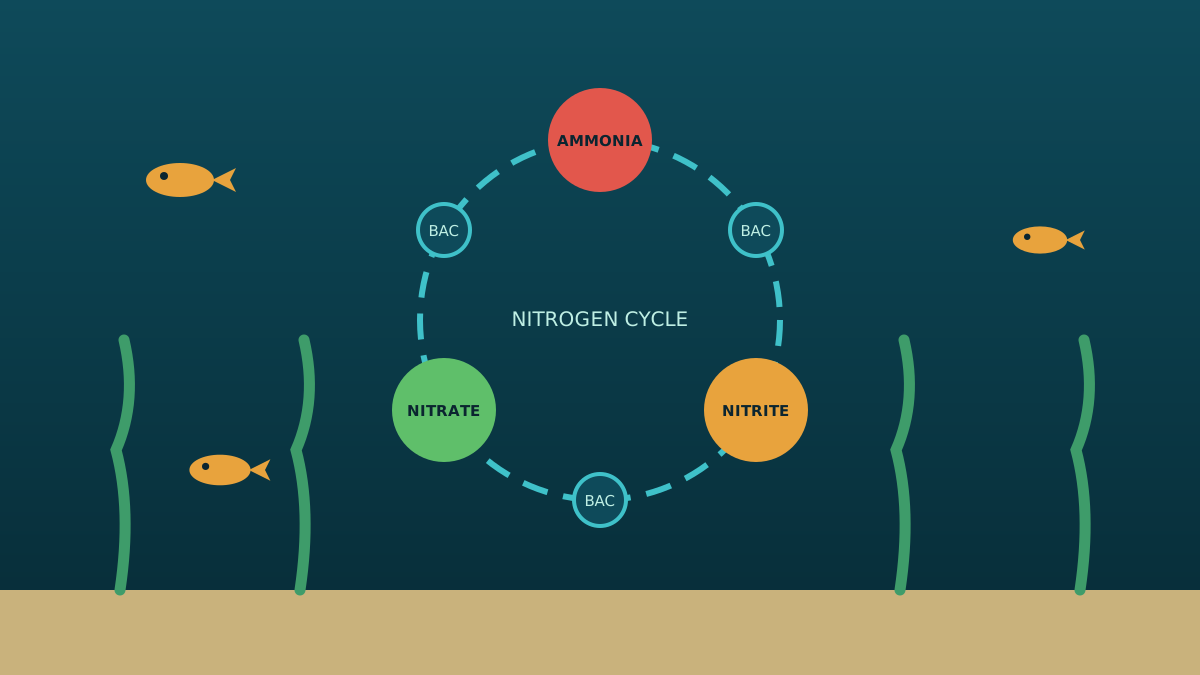
Fish excrete ammonia, and uneaten food and plant debris break down into more of it. Ammonia burns gills and skin at concentrations far below anything visible in clear water. In an established tank you never see it, because two groups of bacteria intercept it within hours.
The chain
One group converts ammonia into nitrite. Nitrite is also toxic — it interferes with the blood's ability to carry oxygen. A second group converts nitrite into nitrate, which fish tolerate at moderate levels and which plants consume as fertiliser. What is left is removed by water changes. Establishing both colonies, in that order, is what the word "cycling" describes.
Fishless cycling, step by step
- Set the tank up completely — substrate, filter running, heater at normal temperature, plants in.
- Add an ammonia source: bottled pure ammonia dosed to a low target, or a pinch of fish food left to decay.
- Test every two or three days. Ammonia rises first, then falls as nitrite appears.
- Nitrite rises, peaks, and eventually falls to zero as the second colony catches up.
- When ammonia and nitrite both read zero within 24 hours of dosing and nitrate is present, the tank is cycled.
Seeding with squeezed filter sponge, gravel or media from a healthy established tank can cut this time dramatically, because you are transplanting the colony rather than growing it from scratch.
Reading the test kit honestly
Liquid test kits are worth the small extra cost over strips, which drift badly with age and humidity. Log the numbers rather than trusting memory — the shape of the curve tells you where you are, and a flat line of zeros with no nitrate usually means nothing has started, not that everything is finished.
After the cycle
Stock slowly. Each new group of fish adds load that the bacteria must grow to meet, and adding a full stocking list at once can restart the whole problem. Feed sparingly, change part of the water weekly, and resist the urge to clean the filter media in tap water — chlorine kills the colony you spent a month building.
Reading a test result instead of guessing
A liquid test kit tells you where a tank is in the cycle, and the pattern of the three numbers is more informative than any single reading.
Ammonia present and nitrite at zero means the first bacterial group has not established yet: the cycle has barely started. Ammonia falling while nitrite climbs means the first group is working and the second has not caught up — this is the most dangerous stage, because nitrite is at least as toxic as ammonia and beginners often read the falling ammonia as success. Ammonia and nitrite both at zero with nitrate present is a cycled tank, and that combination is the only proof that matters.
Two practical notes. Test strips are convenient and consistently less accurate than liquid reagent kits, particularly for nitrite; if you are using them to decide whether to add animals, they are the wrong tool. And test the tap water too — some supplies contain ammonia from chloramine treatment, and a reading you assume is from the tank may have come out of the tap.
Frequently Asked Questions
How long does it take to cycle an aquarium?
Typically four to eight weeks with a fishless method, depending on temperature and how the ammonia source is dosed. Seeded filter media from an established tank can shorten it considerably.
What is new tank syndrome?
Fish loss caused by ammonia and nitrite spikes in a tank whose bacterial colonies have not yet established. It is the single most common beginner mistake.
Do water changes remove the beneficial bacteria?
Almost none. The colonies live on filter media and surfaces, not floating in the water, so routine water changes do not reset a cycle.
Do bottled bacteria products actually work?
Some genuinely shorten the process, but results vary and none of them make a tank instantly safe. Treat any product as an accelerator, not a substitute for testing: the only evidence that a tank is cycled is zero ammonia, zero nitrite and measurable nitrate.
Can I speed up a cycle with filter media from another tank?
Yes, and it is the most reliable shortcut there is. Squeezing out a mature sponge or moving some established media transplants the bacteria directly. Use media only from a tank you know is healthy, since disease travels the same way.
Sources & Further Reading
- University of Florida IFAS Extension — ornamental fish and water quality — ifas.ufl.edu
- World Aquatic Veterinary Medical Association — www.wavma.org
Last updated: 11 August 2026