Stocking a Community Tank Without Regret
Most tanks that go wrong were stocked in one visit, from one display wall, by someone choosing on colour. The fish that fights, the fish that outgrows the tank and the fish that hides for two years all looked identical at two centimetres long.
Ask four questions before buying anything
- How big does it get? Not now — as an adult. This single question prevents most disasters.
- Does it need a group? Shoaling species need numbers, usually six or more of their own kind.
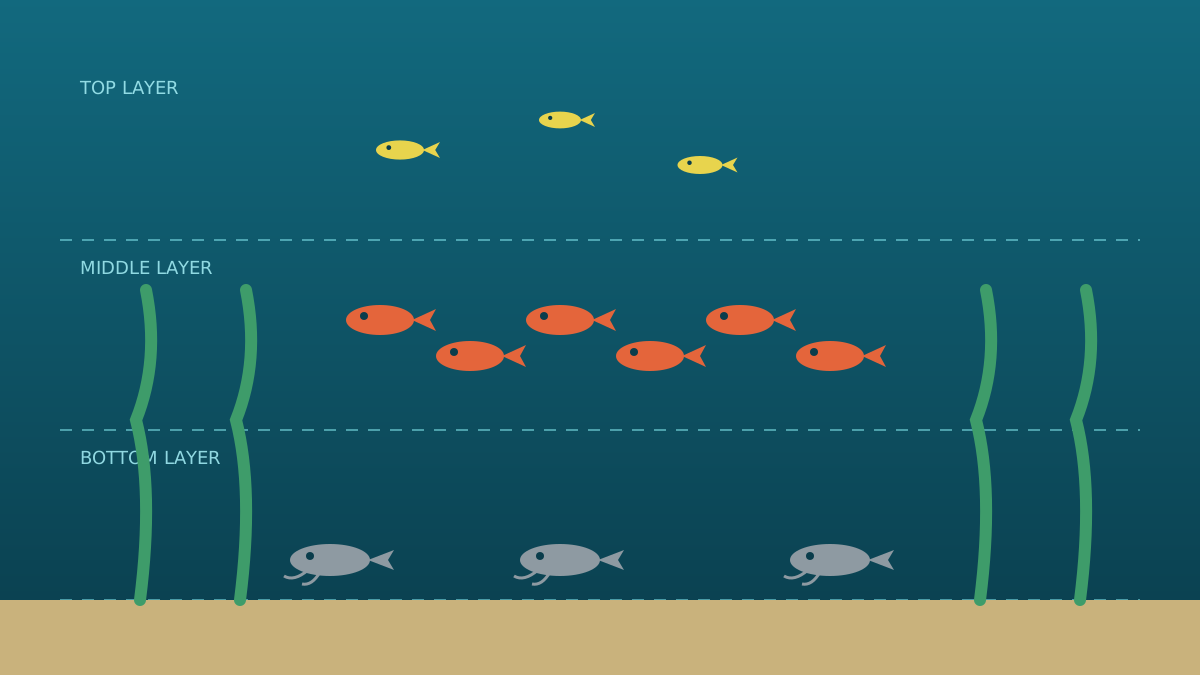
- Which layer does it use? Top, middle or bottom. Spreading species across layers makes a tank look full without overloading it.
- What is its temperament? Peaceful, boisterous, territorial or fin-nipping — and does that match everything else already in the tank?
Layers, not just numbers
A well-planned community distributes occupation. Surface-oriented species patrol the top, active shoalers own the middle, and bottom dwellers work the substrate. Twelve fish spread across three layers feel calmer and look better than twelve fish all competing for the same middle water.
Where conflicts really come from
Aggression in community tanks is usually a design problem rather than a personality problem. Too few hiding places, no line-of-sight breaks, a shoaling species kept in threes, or a territorial fish given a tank with only one good cave — each of these manufactures conflict. Adding wood, plants and a second cave often solves what looked like a bad fish.
The quiet mistakes
Fin-nippers and long-finned fish are a classic mismatch: the nipper is not vicious, the target is simply irresistible. Fast eaters starve slow bottom feeders when all food floats. And a fish sold as suitable for a small tank at three centimetres may be a thirty-centimetre adult with a territory the size of the whole aquarium.
Add in stages
Introduce one group at a time and wait two or three weeks. This keeps the biological filter ahead of the load and lets each group establish before the next arrives. It also means that if something does go wrong, you know exactly which addition caused it.
Introducing new fish without destabilising the tank
A stocking plan that works on paper can still fail in the first week, because adding fish is both a biological load and a social event.
Add in groups, not one at a time. A shoaling species introduced as six settles far faster than the same six added across a month, and the bioload arrives in a step the filter can adjust to rather than a series of small shocks. Between additions, leave two to three weeks and test: ammonia or nitrite appearing after a new group means the filter has not caught up, and adding more is how a cycled tank crashes.
Order matters as well. Put the most peaceful and the least territorial species in first, and add anything with a tendency to claim space last, so it arrives to a tank where territory is already allocated rather than establishing itself in an empty one. When adding to a tank that already has an established territorial fish, rearranging the hardscape immediately before the introduction resets the map for everybody and reliably lowers the aggression that follows.
Frequently Asked Questions
How many fish can I keep in my tank?
The old inch-per-gallon rule is unreliable. Adult size, body shape, activity level, waste output and territory needs matter far more than length alone.
Why do some fish need to be in groups?
Shoaling species use the group for security. Kept alone or in pairs they are chronically stressed, hide constantly, and often become aggressive.
Can I mix fish from different continents?
Physically yes, if temperature and water hardness match. A regional tank often looks more coherent, but compatibility of needs matters more than geography.
Is the 'one inch of fish per gallon' rule useful?
No. It ignores body shape, waste production, activity level, swimming space and shoal requirements, and it produces badly overstocked tanks with active or deep-bodied species. Stock by the requirements of each species instead, starting from adult size.
How do I check a fish's adult size before buying?
Use a researcher-maintained species database rather than the shop label or a care sheet. Search the scientific name, which is the only reliable identifier — common names are reused across completely unrelated fish and often across very different adult sizes.
Sources & Further Reading
- FishBase — species database maintained by research institutions — fishbase.se
- RSPCA — fish welfare guidance — www.rspca.org.uk
Last updated: 11 August 2026